
Cal Poly Students Build University’s First Laser: ‘A Rare and Valuable Skill’

Contact: Nick Wilson | (805) 235-8008 | nwilso28@calpoly.edu
The device was built under the guidance of a Physics Department faculty expert
SAN LUIS OBISPO — Cal Poly students have built the first solid-state laser in the university’s 125-year history.
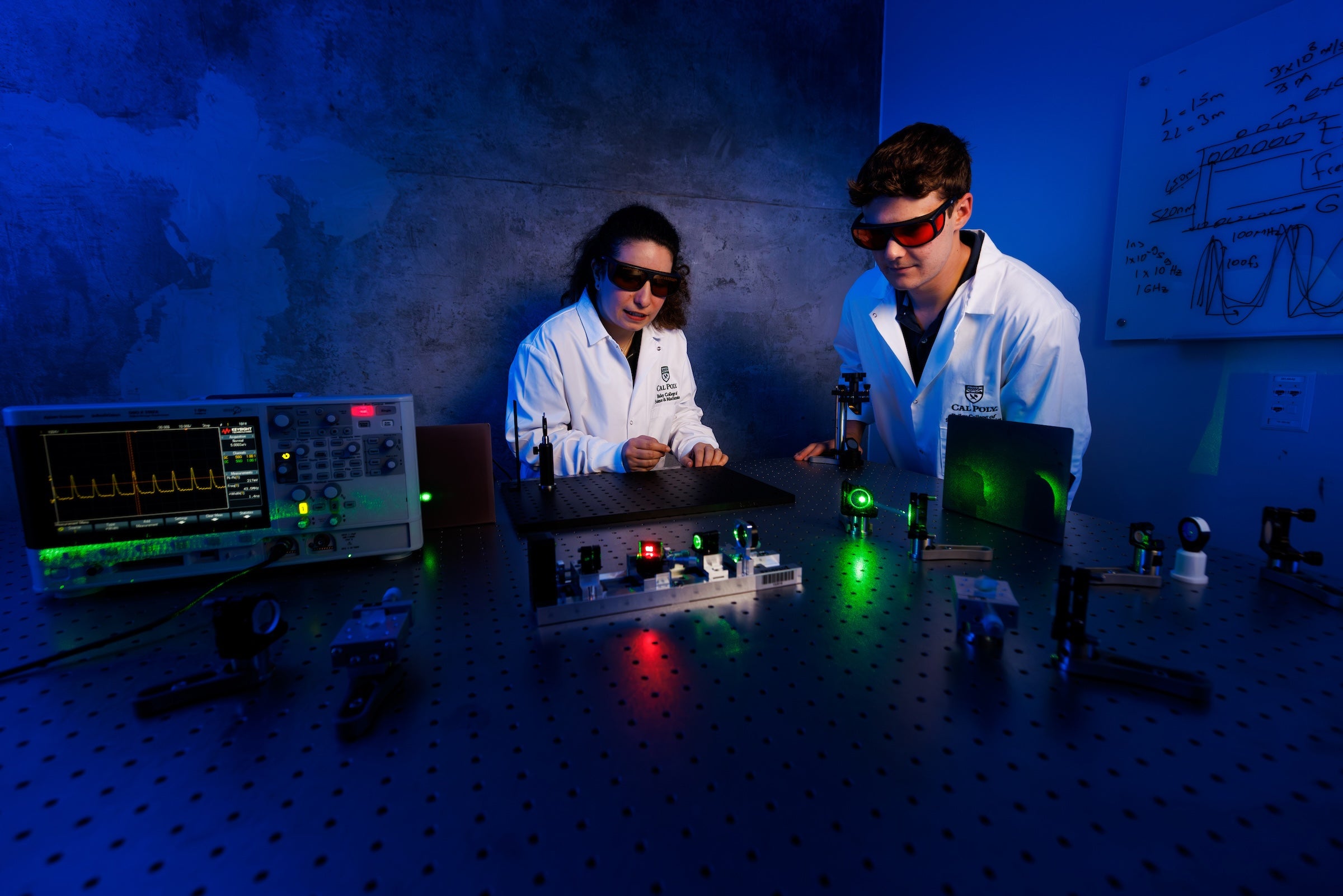
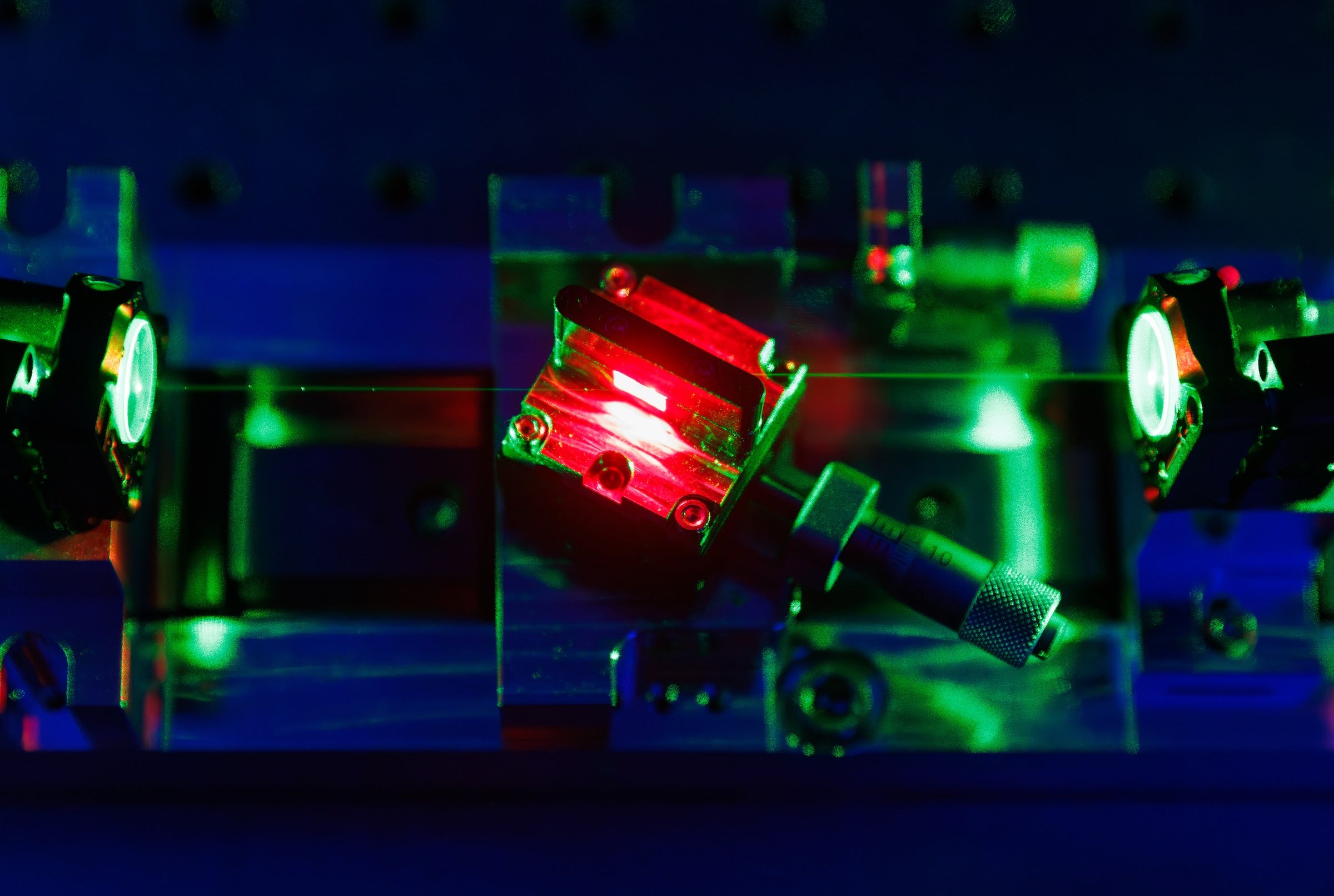
Undergraduate students collaborated with Isinsu Toker, an assistant professor of physics in Bailey College, to construct a titanium-sapphire laser from scratch. The tunable laser, which emits red and near-infrared light, was constructed over three months during the fall and winter quarters.
“This is the very first laser built on campus,” Toker said. “This is a very important step for students, especially undergraduates, to develop a rare and valuable skill that has a wide variety of applications for industry and research.”
Lasers, which generate highly concentrated beams of light, are used in industrial manufacturing, medical procedures, communications, scientific research, consumer electronics and many other forms.
Toker, who specializes in optics (the study of light and how it behaves) and lasers, joined Cal Poly in 2022, after working as a researcher in Istanbul at the Koç University Surface Science and Technology Center, Turkey’s first research center to better understand the surface characteristics of materials and devices, and how they can be modified for specific applications.
While lasers can be purchased commercially, the benefit of constructing them includes opportunities for students to gain hands-on knowledge and to learn how to make modifications for specific laboratory uses.
“A research group using multiphoton microscopy to study biological tissues in fields like cancer research and neuroscience is likely to need someone who’s capable of understanding and building lasers,” Toker said. “Cal Poly students will be ahead of their peers in the field when they enter the workforce with this experience.”
Cal Poly’s first laser was built after securing parts that would be difficult to manufacture on a university campus. But the rest they built painstakingly piece by piece, assembling the device to ensure proper functionality and energy output.
The team also adapted the laser to emit both continuous light and femtosecond pulses — ultra-short bursts lasting one quadrillionth of a second. Femtosecond lasers are often used in scientific research like materials characterization and deep-tissue imaging, and medical device manufacturing, LASIK (vision correction surgery) and more.
The student team is currently working on an even-more complex project, starting from the crystal that amplifies the light in a laser, and building rest of the device, including crystal mounts, lens holders and a rail system to house the components.
Two undergraduate physics students have worked intensively on the project: senior Hannah Bauer, who’s minoring in astronomy, and James Mauck, a first-year student who’s pursuing a double major in chemistry.
“My role was to set up, align, operate and test the laser,” said Mauck of Belmont, California, who helped create the laser mount using 3D design. “I had some experience with mechanical design before college. I was really interested in getting involved in research, and this has been a great opportunity.”
Bauer, who has an interest in telescopes for astronomy study as well, said that the work involved a lot of testing and adjustments.
“Everything has to be very precisely aligned,” said Bauer of San Diego. “During the building process, when something didn’t work, we had to take it all apart and start over. You can actively see how you're manipulating the light, which is really amazing.”
Cal Poly’s new laser technology projects will also assist research-based projects, including ongoing biomedical applications for which the lasers will test for optimum wavelength and color for examining tissue types. Students already have signed up for biomedical study applications for their senior projects. And Toker said she expects to collaborate with faculty and student peers across campus to use laser technology on various research projects.
“Over time at Cal Poly, these applications will grow and involve more research-based studies,” Toker said. “We expect to partner with researchers across campus who may send samples for testing and characterizing with specialized optics equipment.”
About the Project
The laser-building project at Cal Poly received grant funding from the Bailey College of Science and Mathematics and support from the Leonard and Natalie Wall Physics Faculty Research Fellowship. Leonard Wall was a Cal Poly emeritus physics professor who passed away in February. Toker shared photos with Wall and his family of the students building the laser before his death. Some of the laser components were provided by physics alumnus Aaron Dodell (M.S. Materials Engineering, ’00, Physics, ’98) through his employer, General Atomics.
Top photo: Cal Poly physics students James Mauck and Hannah Bauer align a green light pump laser used as part of a project to build Cal Poly’s first laser. A green pump laser excites the crystal, enabling it to emit tunable red and near-infrared light.
Cal Poly photo by Joe Johnston
