
Cal Poly ROTC Commissions Four New Army Officers in Spring Ceremony

Contact: Jay Thompson | 805-235-0955 | jthomp04@calpoly.edu
The newly commissioned officers join the ranks of 1,442 second lieutenants who have progressed through the university’s military science and leadership program since its founding in 1953
SAN LUIS OBISPO — On the eve of the 250th anniversary of the Declaration of Independence, and amid commencement festivities, Cal Poly’s Army ROTC program welcomed four new officers during its spring commissioning ceremony held June 13 at the Officer’s Club at Camp San Luis Obispo.
“This is a very big day for cadets,” Lt. Col. Mark Swiney, who heads the Military Science Department for the Army ROTC Mustang Battalion, told the audience of about 100 family and friends of the quartet. “This is the last time I get to call them cadets. Every decision that these cadets have made up to this point has brought them to this moment. Pretty amazing, right?”
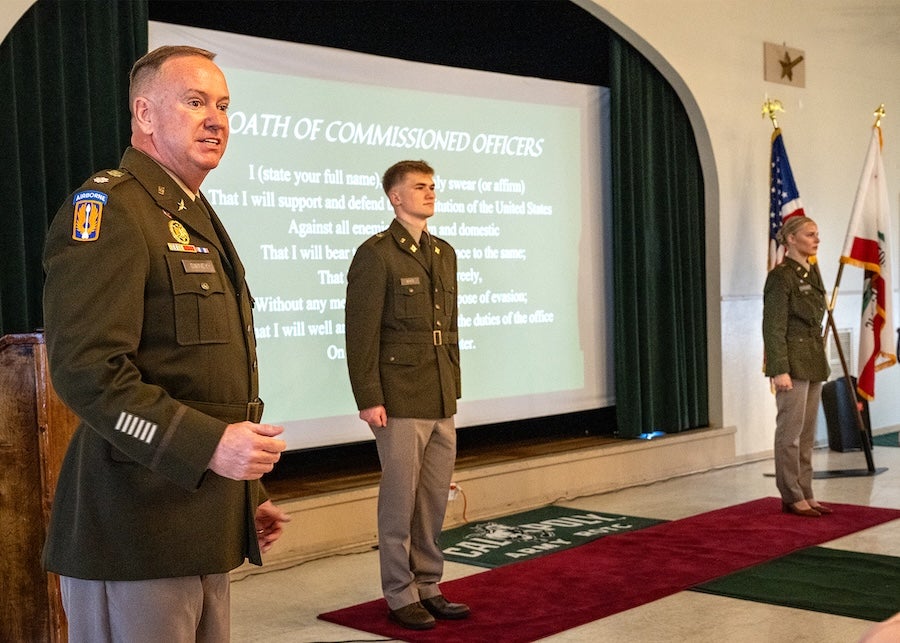
The students, who represent three of the university’s six colleges and Cal Poly Maritime Academy, would soon begin careers as second lieutenants in logistical support, flying and the infantry. Each took the solemn pledge of allegiance to the Constitution, received rank insignia from family and exchanged their first salute as an officer — a longstanding military tradition.
Ann M. De Lay, an associate dean for student success for the Cal Poly’s College of Agriculture, Food and Environmental Sciences, which oversees the program, said these young leaders are ready.
“Each member of this group has poured themselves into a challenging academic program, and if that wasn’t enough, they woke early every morning for (physical training). They completed additional training in a variety of coursework in leadership management, ethics — all beyond what any other student on the campus had fulfilled. They dedicated time and attention to shaping both the internal and the external.”
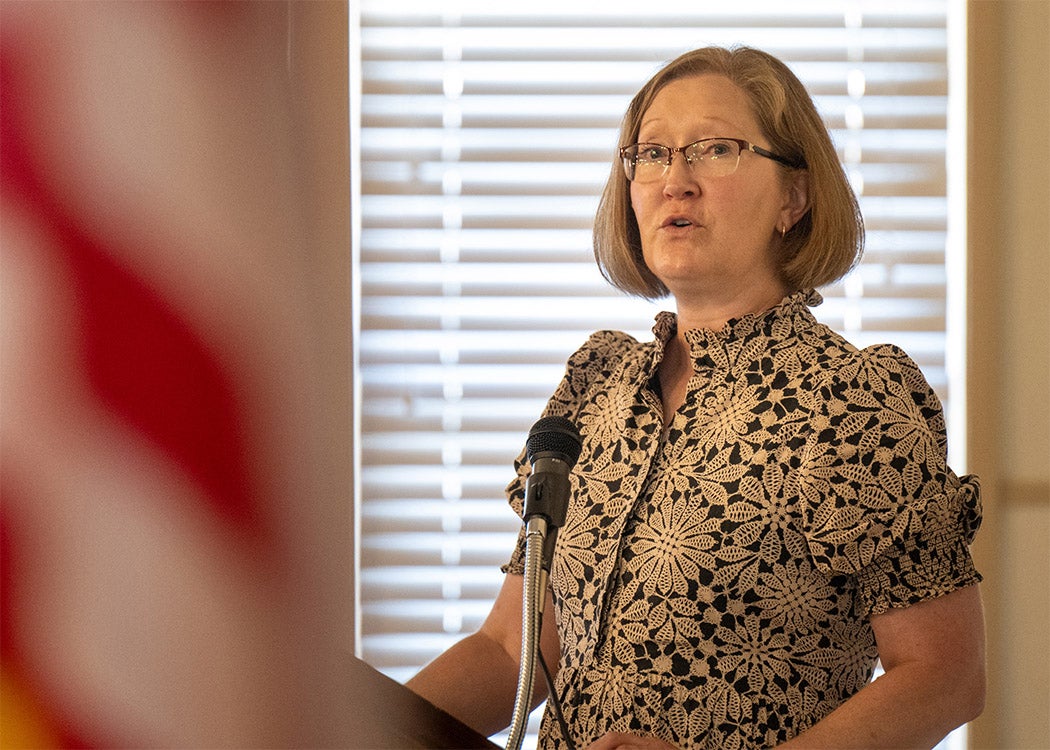
She offered an example of what leadership looks like, relaying a story recalled from the Chowchilla Spring Festival Parade when she was a young girl. As the town’s proud veterans approached carrying U.S. and California flags, her grandmother saw De Lay and her sister seated.
“My grandma quickly ushered us to rise and place our hands over our hearts in reverence,” she said. “I was embarrassed. People to our right and our left were still seated. Why did we have to?
“That day, I learned about the sacrifices so many of our loved ones had made, and the importance of honoring them and their commitment to our country, to Americans past, present and future. I also learned something about leadership that it often looks and acts differently than we expect.
“It can come from humble, familiar origins bearing no formal or fancy title. It can look like things others aren’t willing to do. It can look like standing alone but standing with integrity. It can look like saying the very things that need to be said, even if you don’t feel comfortable saying them. It can look like sharing so others can achieve and inspiring them to carry on a legacy of positivity influencing those around them.”
De Lay advised the four cadets: “Our country and the world need your energy, talent and expertise,” she said. “I believe in you. The entire room clearly believes in you. Cal Poly believes in you. So congratulations and enjoy this moment.”
Cadet Andrew Koenig, second from left, holds his Army commission with
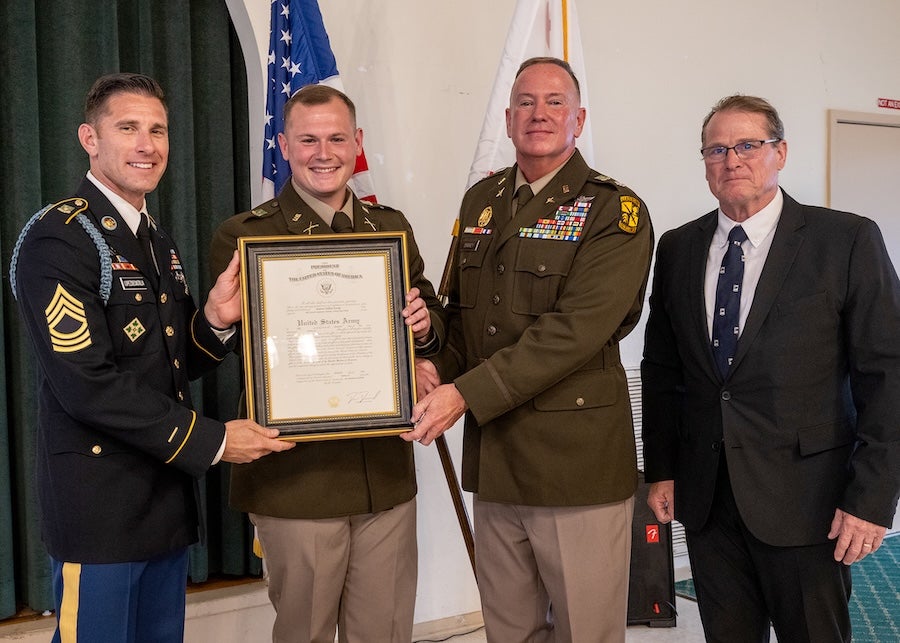
Each student took the Oath of Commissioned Officers, which Swiney pointed out was “one of the most important they will ever take in their life.
“They’re taking an oath to themselves, to the military, to others, to their friends that they will support and defend the Constitution of the United States.”
The cadets completed the public vow and replied in unison: “And that I will well and faithfully discharge the duties of the office on which I am about to enter. So help me God.”
The new officers are:
Isabel Hermann
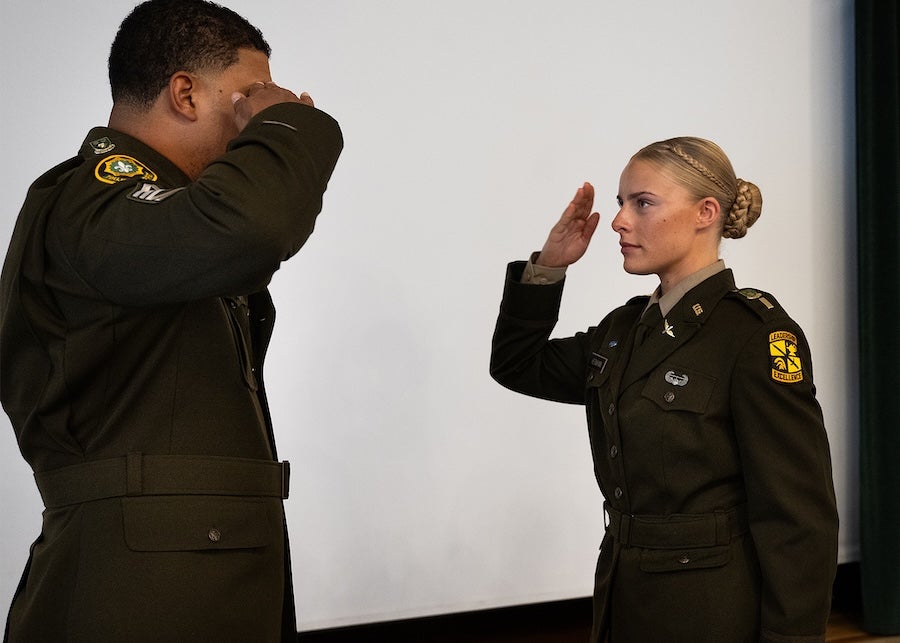
Hermann, a journalism major from Elk Grove, California, joined the ROTC program at the beginning of her second year and quickly drew attention by adapting quickly to ROTC curriculum. As a senior, she was assigned the role as executive officer and tasked with keeping accountability of the battalion. Her goal is to attend flight school to become an Army aviation officer. Hermann will attend the Aviation Basic Officer Leadership Course, or BOLC, a baseline training program for newly commissioned second lieutenants branching into aviation, at Fort Rucker, Alabama. The field portion lasts 4 to 8 weeks, but she won’t receive her wings until completing the entire 14- to 18-month flight training track.
Andrew Koenig
Koenig, a bilingual history major from Merced, California, comes from a family steeped in military tradition. As a future infantry officer, Koenig has always had a knack for physical challenges. As a member of the 1,000-Pound Club and an avid Ranger Challenge cadet, ROTC’s toughest team competition requiring endurance, grit and teamwork under pressure, Koenig never shied away from a physical challenge. In the summer of his junior year, he attended Cadet Troop Leader Training in Hohenfels, Germany, where he discovered his calling to the Infantry. Entering his fourth year, Koenig served as S3 planning battalion events. The assignment is considered the most demanding, fast-paced and critical staff roles in an ROTC detachment. While the battalion commander sets the vision, the S3 actually figures out how to execute it.
Nathaniel Warfield
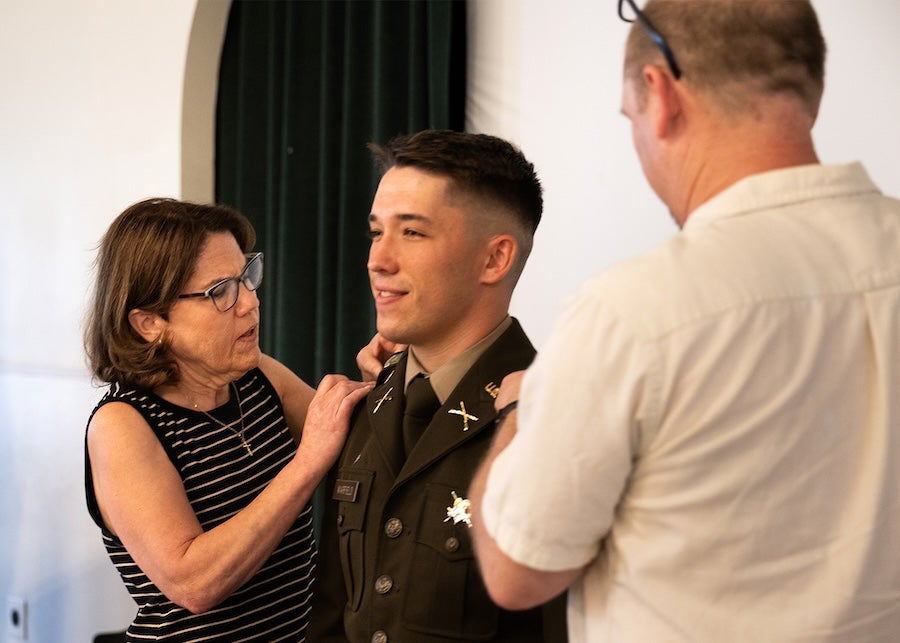
Warfield is a construction management major, who after the Army plans to become a high-end custom home builder. The Monterey, California, resident will start his military career in the Infantry. In his senior year, Warfield served as assistant S3 for the battalion, helping plan operations, as well as Ranger Challenge captain, leading the team for his junior and senior years. Warfield is a graduate of the prestigious U.S. Army Mountain Warfare School, an intense, 14-day military training program at the Ethan Allen Firing Range in Jericho, Vermont, where cadets learn specialized survival, mobility and combat skills for operating in extreme, mountainous terrain and climactic conditions. An expert at knot tying, he often shared his expertise in rappelling and mountaineering. After graduation he will attend the Infantry BOLC, the initial training pipeline for newly commissioned officers, which is held at Fort Moore in Columbus, Georgia, followed by Ranger School, the Army’s premier small-unit leadership and patrolling course.
Avery White
White, from Eagle River, Alaska, located about 15 miles from Anchorage, earned a degree in computer engineering, one of the most challenging majors at Cal Poly. He achieved near straight-A grades and was named to the Dean’s List 10 times for academic excellence. He entered the ROTC program in his sophomore year and was awarded a three-year scholarship. In his fourth year, he served as the S4, the battalion logistics and supply officer, managing supplies and logistics. His work was essential during large joint field training events and every day by sorting out the supply needs of the battalion. White plans to enter the California National Guard as a logistics officer while pursuing a career in software engineering.
Top Photo:
Army 2nd Lt.s Avery White, from left, Isabel Hermann, Nathaniel Warfield and Andrew Koenig. They bring to 1,442, the number of second lieutenants who have progressed through Cal Poly's ROTC military science and leadership program since its founding in 1953.
Cal Poly photo by Jay Thompson
