
Cal Poly Seniors Build Learning Tools for Lucia Mar Students with Complex Medical Needs

Garden box and sensory den at Oceano Elementary help students engage with water movement, light and texture
Contact: Charlotte Tallman, ctallman@calpoly.edu, 805-756-6402
SAN LUIS OBISPO — Every learning tool in Heather McColley’s medically fragile classroom at Oceano Elementary School must meet students where they are. Two Cal Poly mechanical engineering senior project teams took on that challenge with a push-button garden box and sensory den built to bring more moments of response and discovery into the school day.
McColley, who has taught for 22 years, works with Lucia Mar Unified School District students with complex medical needs in the district’s only classroom of its kind. She wanted equipment that could adapt to her students’ needs and give them clearer ways to engage with water movement, light and texture.
Mechanical engineering seniors Gabe Haarberg, Lucas Meneghetti, Matthew Podgorski and Alex Seybold designed the garden box, an angled planter with push-button watering controls. Hannah Henderson, Marcus Kanenaga and Galilea Portillo developed the sensory den, an overhead frame with moving lights, music and textured panels with enough clearance for wheelchairs and hospital beds.
Making both projects usable across the classroom required careful measurements. Because McColley’s class can serve students ages 3 to 22, the teams could not rely on one standard height, reach or viewing angle. Both teams visited Oceano Elementary multiple times as they refined their designs, studying how students would use each project and respond once it was in place.
“They met a community need that we couldn’t meet on our own,” McColley said. “We wouldn’t have even known where to start, but they had the right background.”
The garden box team designed the planter around seated access and stability. To help students see and reach inside, the team angled the box and reinforced it so it could hold wet soil without becoming difficult to move.
“We didn’t want the teacher to have to adjust the wheelchair a lot,” Podgorski said.
The final design pairs a steel frame and heavy caster wheels with an irrigation system adjusted for a smaller planter. Its buttons set off different sprinkler patterns, while clear tubing along the front of the box lets students follow the water before it reaches the soil.
“It’s a way to bring nature to them,” Meneghetti said.
The sensory den team expanded on an existing sensory box McColley’s students already loved. The original setup sat on a table and worked best for smaller children. The new den was scaled for wider classroom use, allowing students to experience it from a wheelchair or hospital bed.
The lights also give McColley and her staff another way to observe students with cerebral palsy and visual impairment as they respond to the display. Because many students communicate without speech, those reactions can help staff see what draws their attention and how quickly they process visual information.
Support from the TECHE Lab helped fund both senior projects, while a Baker-Koob grant allowed the garden box team to upgrade key materials, including casters and wood.
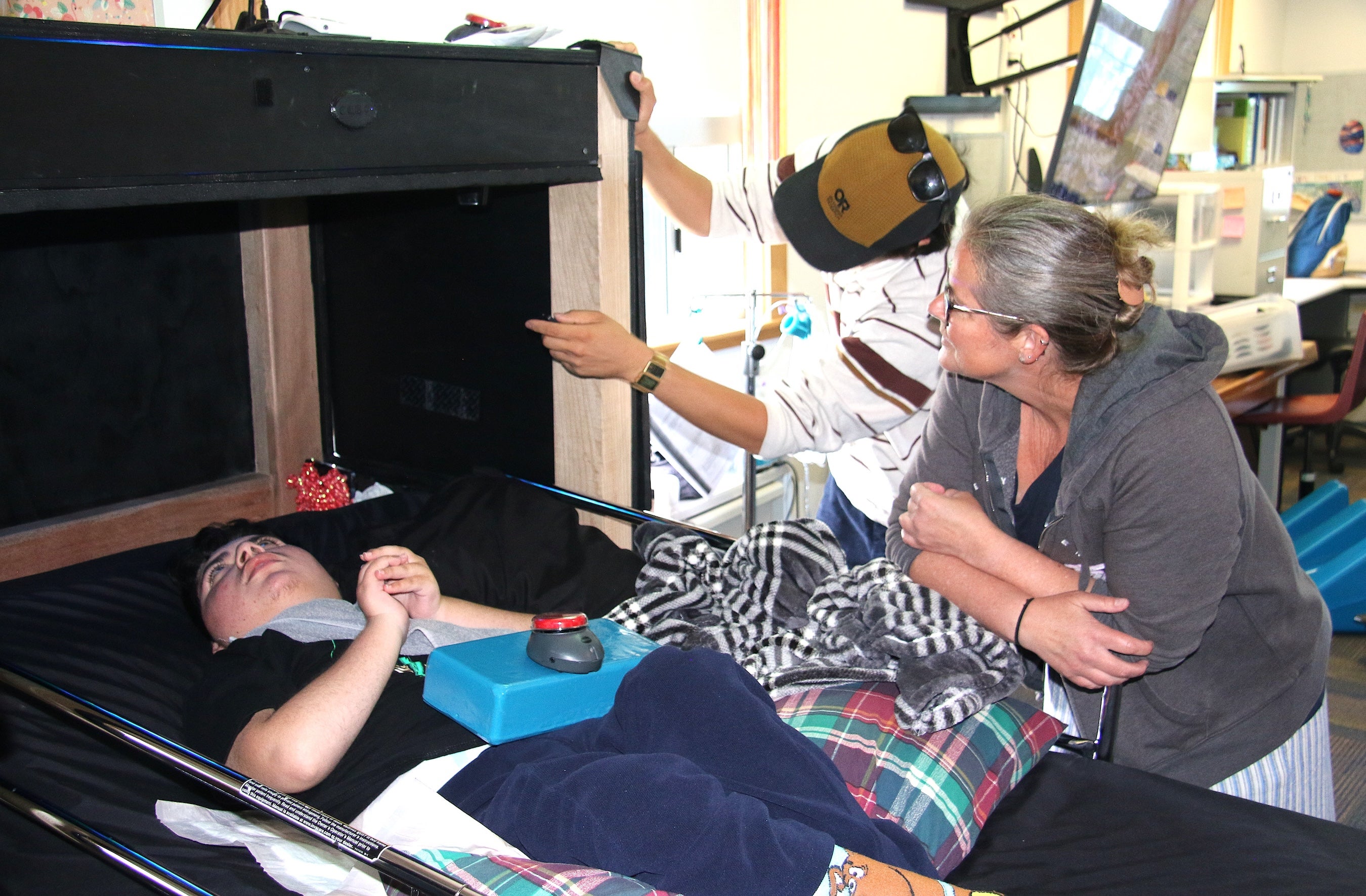
On delivery day, the sensory den was installed in McColley’s classroom, and the garden box was placed on the covered deck outside. Marion, a 7-year-old student with cerebral palsy, used the garden box buttons and smiled as water flowed through the tubing. Inside the classroom, 18-year-old Evan, who also has cerebral palsy, lay beneath the sensory den as his eyes followed the lights shifting above him.
For Henderson, seeing the sensory den in use underscored how much engineers have to consider when designing for different abilities.
“Accessibility affects people in so many different ways,” she said. “It was a good experience in understanding how to design for different types of users.”
###

