
Cal Poly Offers First Synthetic Cell Course to Students, Partnering with Network of Innovative Scientists

Contact: Javin Oza | joza@calpoly.edu, 805-756-0684
The Engineering Synthetic Cells biochemistry course is the first offered at the university as a foundational learning experience for science innovation in partnership with San Francisco-based b.next and Nucleus, their open-source synthetic cell platform and an international science network
SAN LUIS OBISPO, Calif. — A new course at Cal Poly is introducing upper-division undergraduates to the fundamentals of building synthetic cells while collaborating on innovative projects.
The cutting-edge class, Engineering Synthetic Cells, taught by Javin Oza, a Cal Poly biochemistry associate professor, guides students through the process of utilizing cell-free protein expression systems, which involve building synthetic cells from the ground up. The work teaches foundational skills that prepare students for the workforce and could one day lead to breakthroughs in medicine, pharmaceuticals, biotechnology and other industries.
Javin Oza (left), a biochemistry professor at Cal Poly, works in lab with biochemistry student Eva Voss as part of the new Engineering Synthetic Cells course
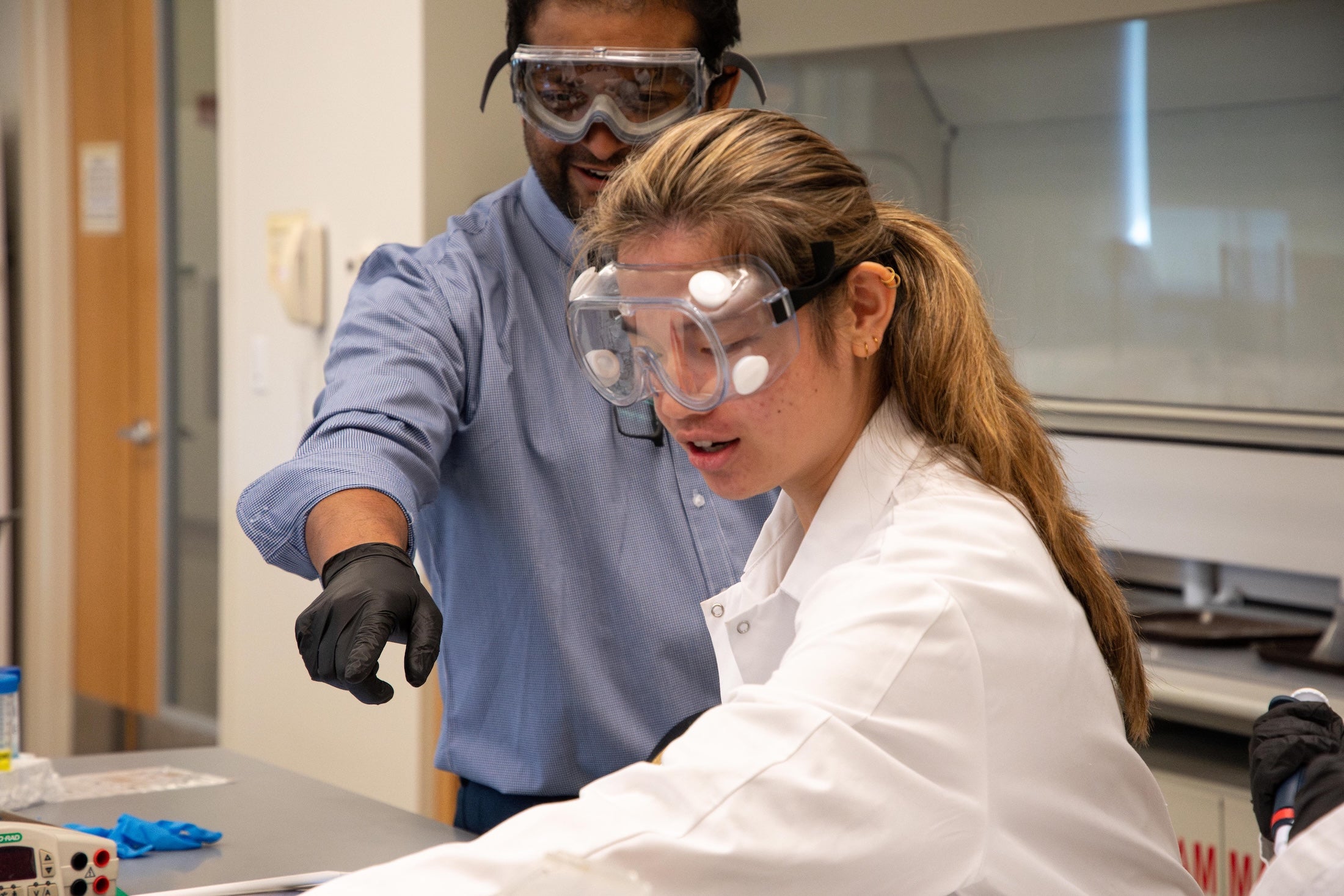
“We’re testing our fundamental understanding of biochemistry by asking what essential parts are needed for functions that sustain life,” Oza said. “If we understand what those processes are, then we can apply them to build our own version of a cell and hopefully use them for various benefits one day. If you build a cell from the ground up, you have the opportunity to do something new and useful that solves a problem.”
Categorized as a Course-based Undergraduate Research Experience, or C.U.R.E., the class combines instructional learning experiences and research, employing lab modules and manuals as students plan and conduct experiments and share information with scientific community members worldwide.
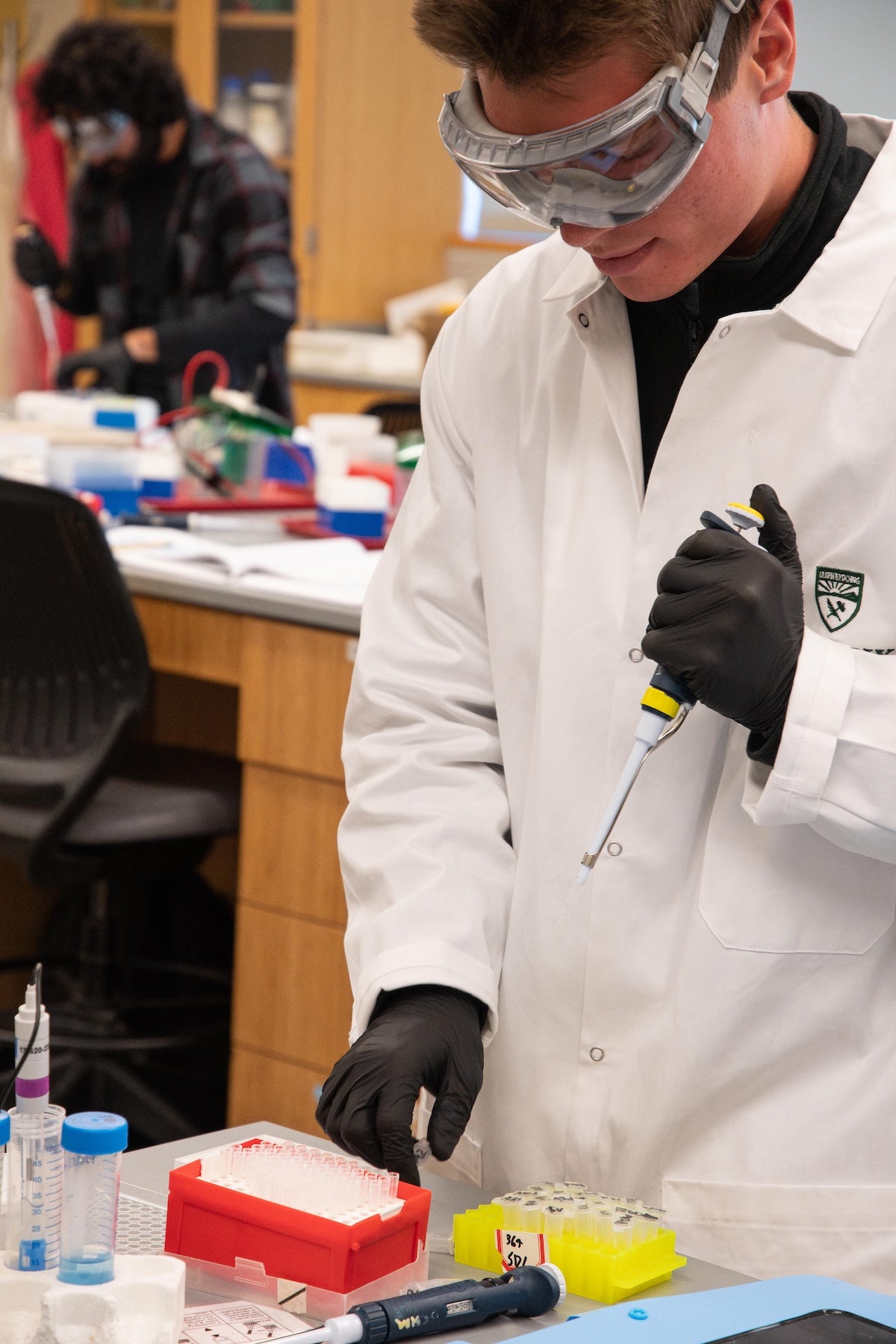
biochemistry student Zach Peterson works in lab in the new “Engineering Synthetic Cells” course biochemistry student Zach Peterson works in lab in the new “Engineering Synthetic Cells” course
As part of a broader scientific collaboration, Oza and his students are working with b.next, a San Francisco-based applied research company that developed and maintains Nucleus, an open-source platform for building synthetic cells. Nucleus supports collaborative research across a growing network of research labs worldwide. Cal Poly’s participation is supported by a Schmidt Sciences grant that also funds partner labs at Northwestern University, the University of Michigan, University College London, Imperial College London and King’s College London.
“As a team in class, we’re able to troubleshoot together, but also we’re able to contact other scientists doing a variety of types of research,” said Emmerson Heery, a biological sciences major from San Jose, California, who hopes to conduct cancer research in their future career. “It’s a nice simultaneous collaboration. Even though the work (with partner institutions) is taking place at separate facilities, we’re sharing our data and troubleshooting.”
As a laboratory course, students are also gaining experience with advanced methods and equipment. Madison, Wisconsin-based Promega Corp., a global biotechnology company with an office in San Luis Obispo, has contributed instrumentation to support the course work, including a multimode microplate reader and assay kits used for chemical testing. And b.next provided a high-powered, fully motorized fluorescence microscope in collaboration with Cephla, a Mountain View-based microscope manufacturer.
“The course being developed at Cal Poly demonstrates what Nucleus is designed to enable: students and researchers contributing real experimental work to a shared scientific commons that others will be able to build upon,” said Anton Molina, b.next’s head of Open Source Ecosystem. “It was not uncommon for a newcomer to this field to take 10 weeks just to figure out how to make synthetic cells from scratch. Nucleus moves the starting line forward so that people can do interesting science faster instead of reinventing the wheel. As this scales to more institutions, I’m excited for what’s possible when that work begins to compound.”
Beyond its course commitment, Schmidt Sciences, a philanthropic organization founded by Eric Schmidt (a former Google CEO) and Wendy Schmidt, will continue to support undergraduate research experiences at Cal Poly, funding four full-time undergraduate researchers and the university’s first team at the International Genetically Engineered Machine (iGEM) Competition, showcasing Learn by Doing, Nucleus and synthetic cells experiences in Paris in November.
“A big part of our goal for the Developer Cell project (backed by Schmidt Sciences) is to allow more people to learn about biology and biological engineering by doing experimental work on the open source Nucleus platform,” said Richard Murray, a Caltech professor and senior advisor at Schmidt Sciences. “Having course materials that allow undergraduate students to learn about biology and biotechnology by doing experiments is a great contribution to the community, in addition to getting feedback from students who are going through the course and playing a role in helping develop the teaching materials.”
Oza added that bioengineering is a field that has been around for a long time, but success has been limited due to complexities of biological systems and lack of shared, open-source scientific expertise. The ongoing work with synthetic cells and the Nucleus platform can contribute to better understanding of biomedicine development in the scientific community and help prepare Cal Poly graduates for future careers, he added.
Cal Poly students in the course also conducted experiments on a little-studied enzyme called polyphosphate kinase 2 that has the potential to extend the duration of energy regeneration (restoring or recycling energy) in synthetic cells. The work uses bioprospecting, searching nature for useful biological components, to augment synthetic cells with new functionality. Such an effort not only helps understand how biochemical parts function but also how they assemble in a cell-like environment with increasing complexity.
Biochemistry major Eva Voss, of San Luis Obispo, who plans to pursue a medical degree and a doctorate after her graduation in June, said that the course helped her and her classmates to think beyond completing an assignment and conceptualize ways to break new ground.
“I feel like this kind of work is something that a lot of industry people get to do, and not a lot of students get to do as undergraduates,” Voss said. “It’s a rare and humble opportunity, especially because it hasn’t been done before, and we’re the ones making the pathway and helping in the scientific community.”
Alyssa Chew, a biochemistry major from Cupertino, California, hopes to work in the biotechnology industry after completing graduate school.
“I’ve been able to apply all of the experiences from other Cal Poly biochemistry classes to this course, which I do very much believe is close to what you do in industry,” Chew said. “It helps to really bridge that gap, especially as an undergraduate student, and prepare us for what a lot of us are all aiming to do after graduation. It’s very exciting to combine our collective expertise and push toward advancements.”
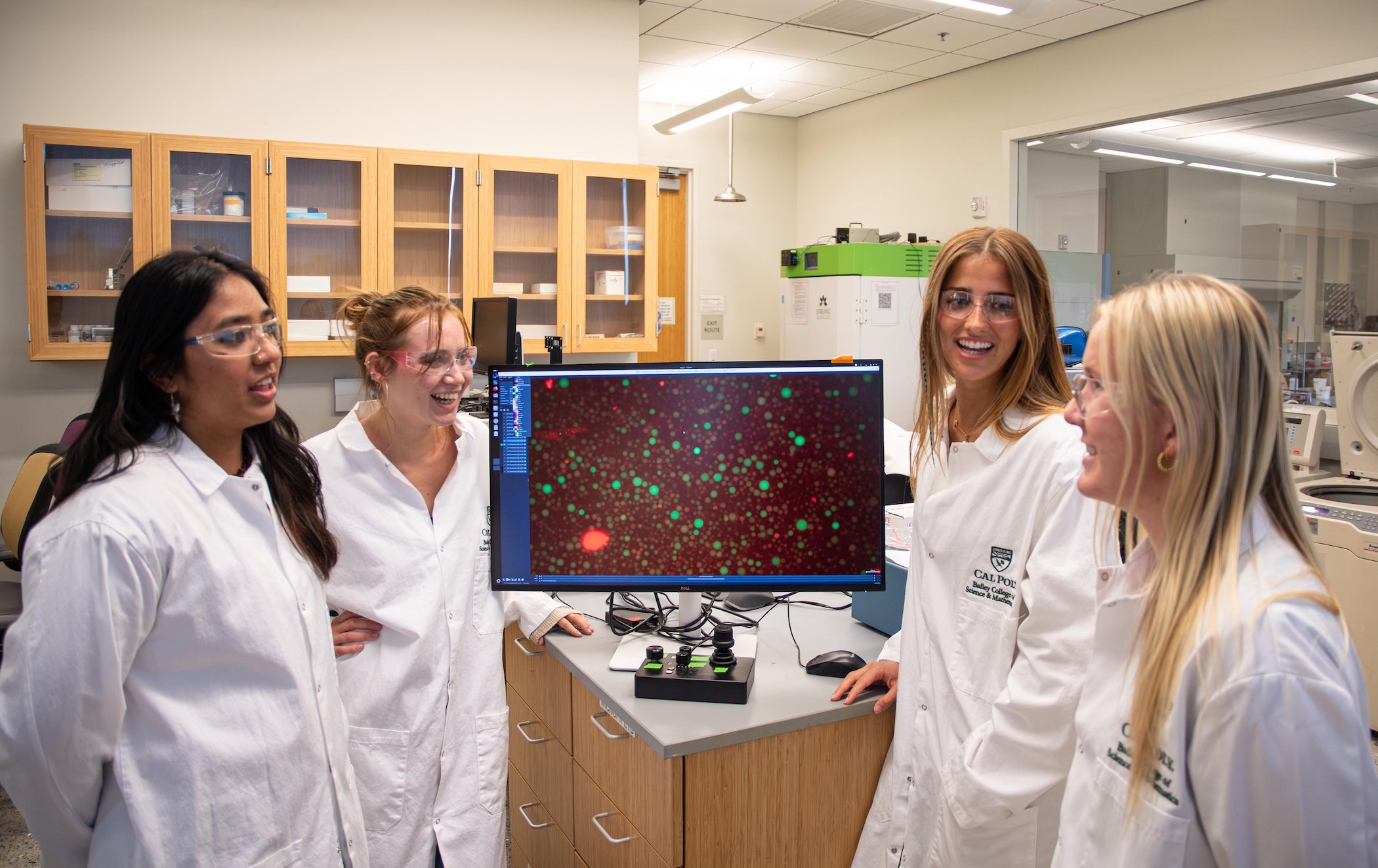
Top photo: From left, Cal Poly biochemistry research students Clara Lillie and Sunayana Nguyen discuss green fluorescent protein (GFP) pictured on the computer monitor with Professor Javin Oza. Scientists use GFP in genetic engineering as a visual tag to track proteins, observe cells, and monitor gene activity in living organisms.
Cal Poly photo by Nick Wilson
