
Cal Poly Team Wins NASA Human Lander Challenge with Cold-Water System for Space Missions
Contact: Emily Slater, 805-266-0208; emslater@calpoly.edu
SAN LUIS OBISPO — A Cal Poly mechanical engineering senior project team won first place overall in NASA’s 2026 Human Lander Challenge with a system that could give astronauts access to cold drinking water during future lunar and Mars missions.
The national competition held June 23-25 in Huntsville, Alabama, challenged college teams to develop solutions tied to environmental control and life support systems for long-duration human spaceflight. Cal Poly took first place ahead of Purdue University, which placed second, and Embry-Riddle Aeronautical University, Daytona Beach, which placed third.
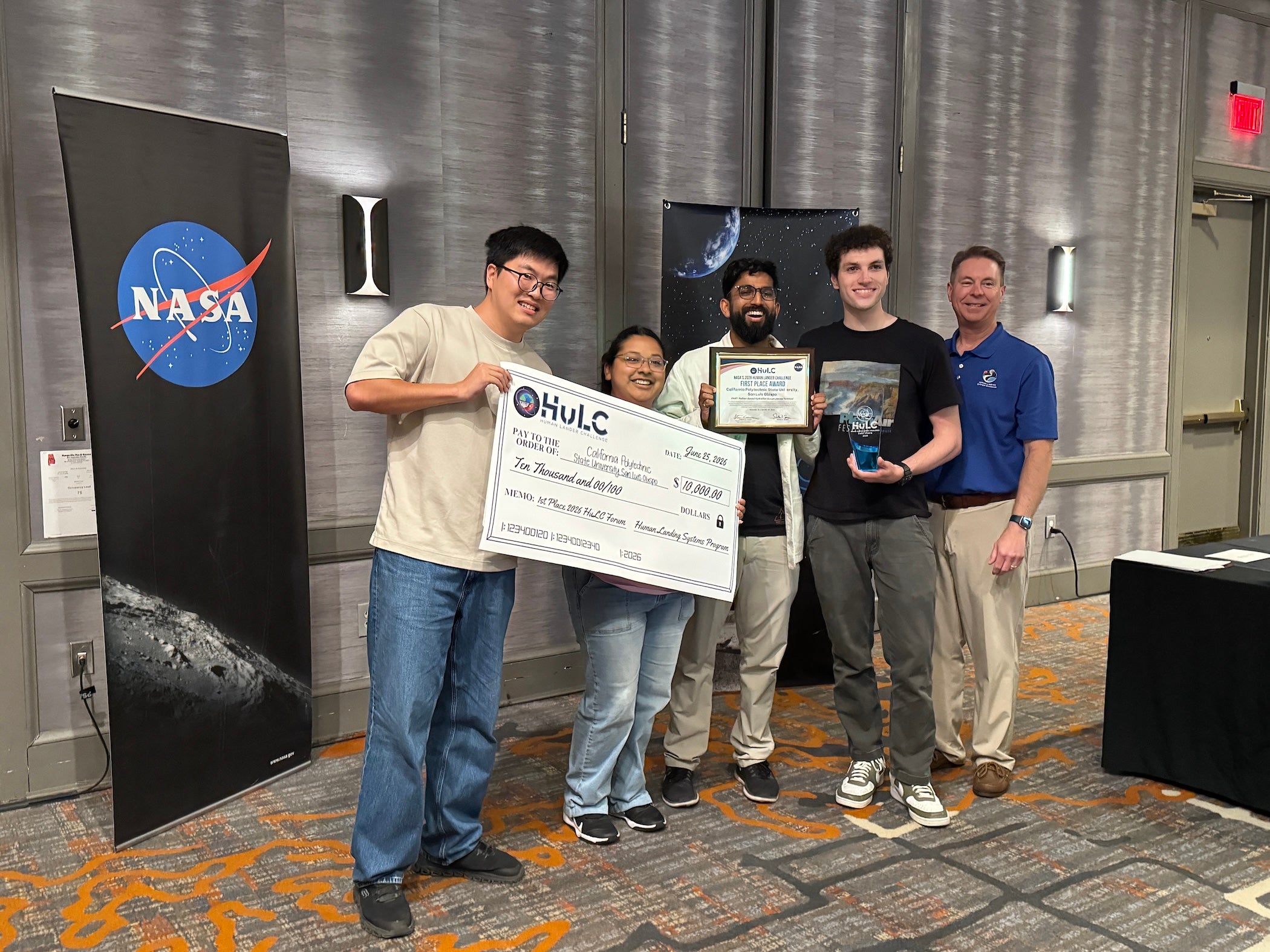
The winning project, PHAT, short for Peltier-based Hydration Accumulation Terminal, started with a practical question: How could astronauts get cold drinking water from spacecraft systems that currently provide only hot and ambient water?
Their answer was a modular add-on to existing spacecraft water dispensers, developed by mechanical engineering seniors Taehoon Lee, Sabrina Luo, Jenner Mucher, Ethan Pace, Tarsem Pal and Renee Rebolledo. The team was advised by John Chen, professor of mechanical engineering, with support from mechanical engineering lecturer Rick Lasko, who served as senior project coach.
The design preserves hot and ambient dispensing while adding a thermoelectric cold-water subsystem that avoids refrigerants and compressors and is intended to support both 30-day lunar missions and longer trips to Mars.
“I really think they liked that our design was simple enough, had little risk, was safe and would be easy to integrate,” Pal said.
That mix of practical design and engaging delivery came through in the team’s presentation, with the PHAT acronym giving judges a memorable point of connection in a highly technical competition.
The final round required teams to submit a technical paper, deliver a 25-minute presentation, answer questions from judges and take part in a poster session. The technical paper counted for 70% of the score, with the presentation and poster session making up the rest.
The win capped a strong year for Cal Poly in the Human Lander Challenge. Three Cal Poly mechanical engineering senior project teams were named finalists this spring, the largest showing in the 12-team field. Each entered the final round with prototype work and testing behind it, giving students a tangible foundation for their presentations to NASA and industry judges. The other Cal Poly finalist teams focused on reducing cabin noise inside a human lander and improving fluid transfer on the lunar surface.
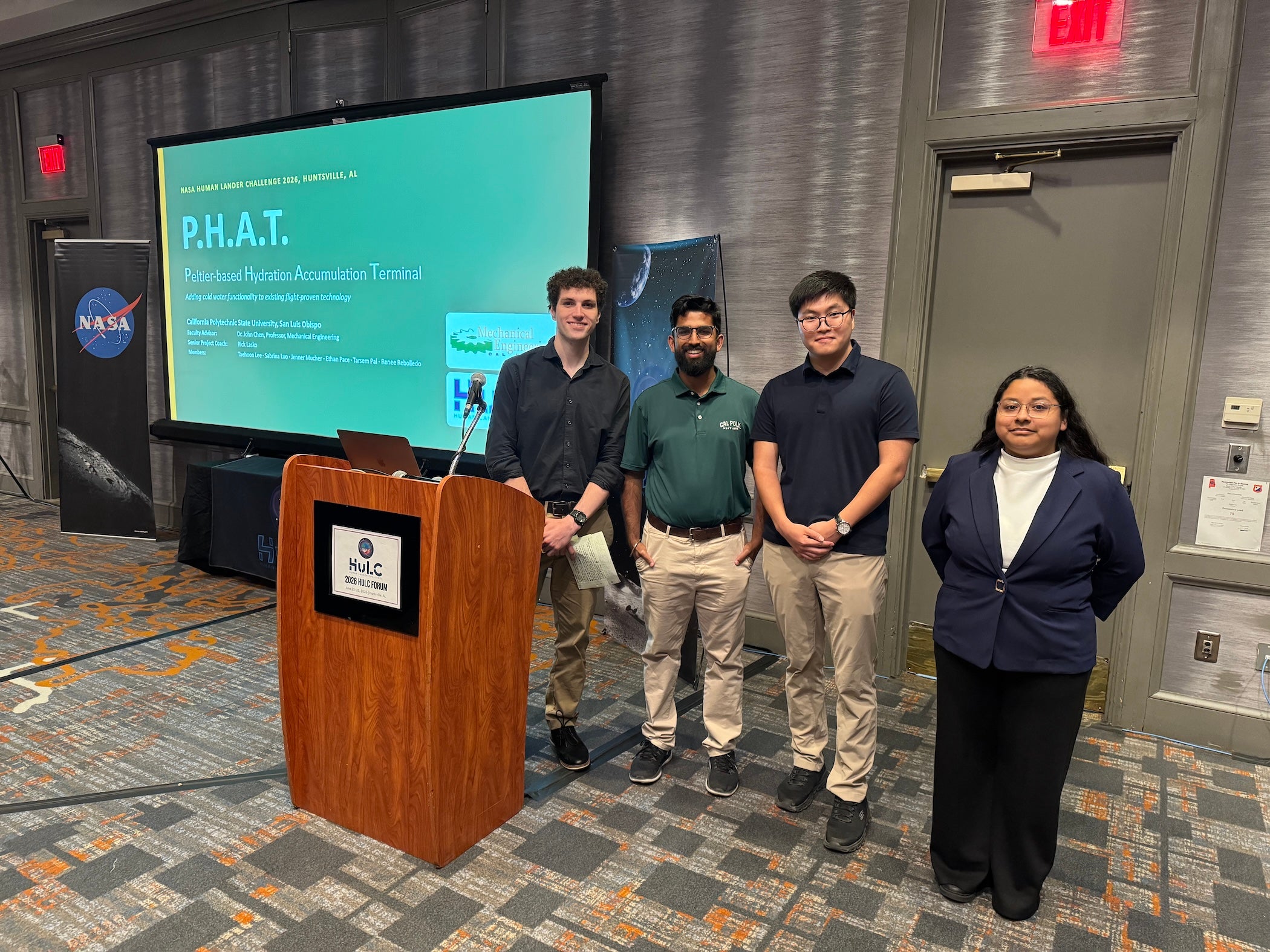
The competition also gave students a clearer view of how Cal Poly’s Learn by Doing approach translated beyond campus. Pace said the team’s prototype work and testing helped them speak with confidence in front of NASA and industry judges.
“Learn by Doing is real,” Pace said. “You see it when you compare Cal Poly to other teams.”
Pal said one judge told the team the concept could have a future beyond the competition. The team’s technical paper will also be added to NASA’s repository, giving PHAT a place in the broader record of ideas being explored for future life-support systems.
###

